You built a website. You invested in SEO. Your pages rank on Google and traffic comes in.
But a growing share of your potential customers skip Google entirely.
They open ChatGPT and type: "What's the best digital marketing agency for a small business?" They ask Perplexity: "Which SEO company should I hire?" They read Google's AI Overview instead of clicking any results.
If your brand is not in those AI-generated answers, you are invisible in an entire category of searches that grows every month.
Over 60% of Google searches now end without a single click. ChatGPT reached 800 million weekly users by late 2025. AI-sourced referral traffic grew 527% between January and May 2025. The way people find businesses has shifted in a way that keyword rankings alone cannot address.
This is the discipline of Generative Engine Optimization (GEO). This guide explains what GEO is, how it differs from traditional SEO, why 2026 is the right time to act on it, and the specific steps to get your brand cited inside AI-generated answers.
Check your current standing with our free AI visibility analyzer before diving in.
What You Will Learn?
- What Is GEO and Why It Matters in 2026?
- GEO vs. SEO vs. AEO Compared
- Why GEO Matters Right Now?
- How AI Engines Read and Cite Content
- How to Write Content That Gets Cited by AI?
- Schema, Site Structure, and AI Crawlability
- How to Build Off-Page Authority for AI Trust?
- Platform-Specific GEO Strategies
- How to Measure GEO Performance?
- GEO Implementation Checklist
- Frequently Asked Questions
What Is GEO and Why It Matters in 2026?
Generative Engine Optimization (GEO) is the practice of optimizing your digital content so that AI-powered platforms, including ChatGPT, Google AI Overviews, Perplexity, Claude, Gemini, and Copilot, cite or recommend your brand when users ask questions relevant to your business.
The term was introduced in a November 2023 research paper by Pranjal Aggarwal, Vishvak Murahari, and colleagues at Princeton and Georgia Tech. That paper introduced the first structured framework for improving content visibility inside generative engine responses, and proved that specific optimization strategies can boost AI visibility by up to 40%. By 2026, GEO has become a core discipline for any business that wants to stay visible as AI-generated answers take a larger share of search traffic.
Here is the distinction that makes GEO different from everything in the standard SEO toolkit. Traditional search engines rank pages. AI engines synthesize answers.
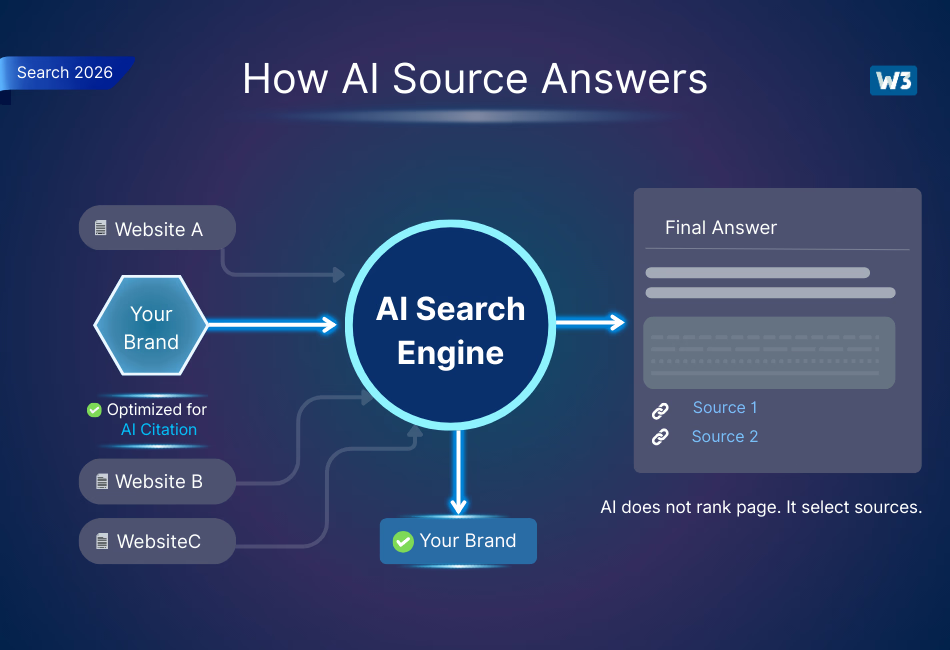
When someone types a query into Google, they see a list of results and click through to find information. When someone asks ChatGPT the same question, the AI reads multiple sources, processes them, and delivers one direct answer with citations. If your content is not among the trusted sources the AI draws from, no link appears, no traffic comes, and you do not exist in that exchange.
Weekly ChatGPT users as of late 2025
Google searches now ending without a click
Growth in AI-sourced referral traffic, Jan to May 2025
Consumers using AI search as their primary research method as of Oct 2025
GEO has three core objectives. The first is visibility: appearing in AI-generated answers at all. The second is citation: being the specific source the AI references. The third is synthesis authority: having your content trusted consistently enough that AI platforms build recurring answers around it.
GEO in Practice: For the bootstrapped form builder Tally, ChatGPT became the number one referral traffic source after consistent GEO implementation. Some enterprise sites now derive over 10% of new signups from AI referral traffic. This is not a future scenario. It is happening right now across industries of every size.
GEO vs. SEO vs. AEO Compared
Understanding how GEO, SEO, and AEO differ and how they work together is the right starting point before building any strategy. Each one captures a different slice of modern search behavior, and each becomes more effective when supported by the others.
| Factor | Traditional SEO | AEO (Answer Engine Optimization) | GEO (Generative Engine Optimization) |
|---|---|---|---|
| Primary Goal | Rank high in Google SERPs | Win featured snippets and direct Google answer boxes | Get cited inside AI-generated answers across ChatGPT, Perplexity, Gemini, and Google AI Overviews |
| Key Signals | Keywords, backlinks, technical performance, E-E-A-T | Concise answers, structured data, question-format content | Fact density, schema markup, entity recognition, authoritative citations, content structure |
| Primary Metric | Rankings, organic clicks, impressions | Featured snippet appearances, zero-click visibility | Share of Model (SoM), AI citation frequency, brand mentions in AI responses |
| Content Format | Keyword-optimized articles, landing pages, pillar content | Direct answers, FAQ format, concise definitions | Answer-first content, comprehensive guides, data-rich pages, multi-platform presence |
| Primary Platforms | Google, Bing | Google (featured snippets, People Also Ask) | ChatGPT, Google AI Overviews, Perplexity, Claude, Gemini, Copilot |
| Does it replace the others? | No. SEO is the foundation. AEO captures answer boxes. GEO earns AI citations. All three work together and each makes the others more effective. | ||
AEO stands for Answer Engine Optimization. It focuses on winning the featured snippets and direct answer boxes that Google displays above standard organic results. GEO extends that concept to AI-generated answers across multiple platforms, with a different set of technical requirements and content structures. Search Engine Land's detailed GEO guide maps out exactly where the two disciplines converge and separate in 2026.
We also cover this convergence specifically in our analysis of why chasing AI Overview rankings misses the point and what to focus on instead.
Why GEO Matters Right Now?
The urgency behind GEO comes down to one specific dynamic: citation patterns form early and reinforce themselves over time.
Once an AI platform consistently identifies a website or brand as a reliable, authoritative source for a particular topic, that pattern reinforces itself. The AI returns to that source repeatedly. Brands that establish citation presence now are building a lead that gets harder to close every month. Businesses waiting are watching that gap widen.
of B2B buyers use generative AI as a key source of self-guided research throughout their purchasing process, according to Forrester 2025
The Traffic Shift Is Already in the Data
When Google AI Overviews appear, organic click-through rates drop by 61% for sites not cited inside them. But sites that do get cited inside AI Overviews earn 35% more clicks than standard organic listings below the AI answer. The same development that reduces traffic for uncited sites creates a measurable windfall for cited ones.
According to BrightEdge's research spanning January through August 2025, AI search visits are growing at double-digit rates month over month. Their data also makes an important distinction: while AI search is the fastest-growing referral channel, organic search still drives higher conversion volume, which means GEO and SEO are genuinely complementary rather than competing priorities.
SparkToro and Datos research from August 2025 found that heavy AI tool usage grew from 3% of US desktop devices in January 2023 to 21% in June 2025. Traditional search did not decline during this period. Both grew together. This tells you that AI search is capturing net-new search behavior, not replacing existing behavior, which is why brands that act early capture both audiences.
As of September 2025, only 16% of brands systematically track AI search performance. Most of your direct competitors have not started. That window closes as GEO awareness spreads.
This applies across sectors. Retailers need GEO just as much as service businesses. Our post on the 2026 Google Product ID update for retailers covers how structured data requirements are converging with GEO specifically for e-commerce. And for the full picture of how AI is reshaping consumer behavior across every channel, see our breakdown of the seven AI marketing shifts changing consumer behavior in 2026.
The Real Cost of Waiting: Adobe research shows 87% of consumers are more likely to use AI for significant purchases. If your brand is absent from AI-generated answers in those high-stakes research moments, you hand those conversations to competitors who invested in GEO earlier. The cost is not just traffic. It is decisions made before a potential customer ever reaches your website.
How AI Engines Actually Read and Cite Content?
To earn citations consistently, you need to understand how AI search engines process content. The pipeline is more specific than most marketers realize, and it has direct implications for how you write, structure, and mark up every page on your site.
How Retrieval-Augmented Generation Determines What Gets Cited
Most AI search engines use a process called Retrieval-Augmented Generation (RAG). When a user submits a query, the AI does not rely solely on its training data. It actively retrieves current, relevant content from the web, evaluates each source for authority and structure, and synthesizes those sources into a single generated answer.
As HubSpot explains in their RAG overview, the process works in three stages: retrieval (finding relevant documents), augmentation (processing and understanding the content), and generation (creating the final response from those sources). The practical consequence for GEO is that your content needs to survive this extraction process intact, with its key claims clearly accessible.
Content freshness matters. Structure matters. Authority signals matter. Content that is clean, well-organized, and factually grounded gets cited. Content buried in complex navigation, poorly structured, or lacking verifiable claims gets skipped regardless of traditional search rankings.
What Happens When an AI Crawler Reads Your Page?
An AI crawler works with specific extraction priorities. It requests your raw HTML, strips boilerplate elements like navigation and footers, tokenizes the remaining content, and builds vector embeddings that represent the semantic meaning of each passage. These embeddings match against user queries based on meaning, not just keyword overlap.
AI context windows have finite token capacity. Bloated markup, repetitive boilerplate, and buried answers all reduce the proportion of useful signal the AI can extract from your page. If your primary answer is preceded by thousands of words of introduction and navigation, the AI may never extract it accurately.
The Signals AI Systems Use to Decide What Gets Cited
The Princeton GEO research paper, along with follow-up studies published in 2025, identifies the specific factors that drive AI citation decisions.
7 Factors AI Systems Use to Choose Which Sources to Cite
- Semantic completeness: Can the content answer the query fully on its own, without the reader needing to look elsewhere? Self-contained answer passages are the strongest predictor of AI citation in the Princeton GEO-bench research, with a correlation coefficient of r=0.87.
- E-E-A-T authority signals: Expert credentials, verifiable authorship, and demonstrated subject expertise appear in 96% of AI-cited content. According to Content Marketing Institute's 2026 trends report, LLMs increasingly reward real experience and trust signals over volume or formatting alone.
- Structured data markup: Pages with schema markup show a 73% higher selection rate in AI citations compared to unmarked content. Schema removes ambiguity about what your content is and who it is from.
- Fact density: Specific statistics, data points, named entities, and citations to primary research make content far more citation-worthy than general claims or marketing language.
- Content freshness: Among AI-cited sources, 79.1% were updated within 2025, with 26% updated in the two months before they were cited. Outdated content loses citation priority over time.
- Multi-modal content: Content combining text, images, and video shows a 156% higher selection rate in Google AI Overviews. A text-only approach leaves significant citation opportunity unused.
- Entity density and clarity: Content with 15 or more clearly defined, connected entities earns a 4.8x citation boost in AI systems. Named people, organizations, places, products, and concepts should be stated precisely and consistently throughout.
How to Write Content That Gets Cited by AI?
Content is the core input for GEO. AI engines consume it differently from human readers and differently from traditional search crawlers. Your content strategy needs to serve all three simultaneously, and that requires specific structural and editorial decisions on every page you publish.
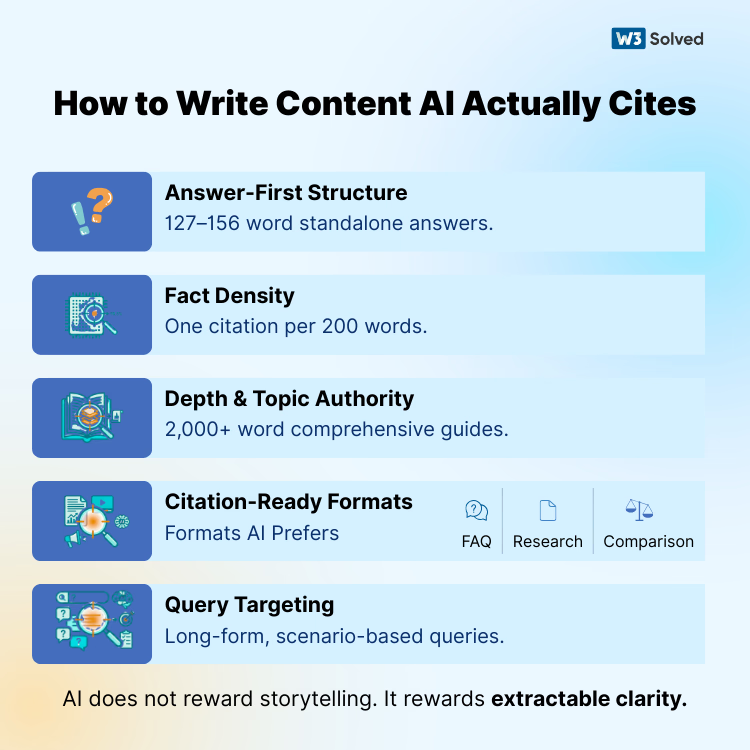
1. Answer-First Formatting
The single highest-impact content change you can make for GEO is adopting answer-first formatting. Place the direct, complete answer to the question at the start of every section. Then provide supporting detail, context, and evidence.
AI systems extract specific passages to cite. A passage that opens with a full, standalone answer is far easier to extract accurately than one that builds toward the answer over several paragraphs. Answer-first content improves AI citation rates by 60% compared to traditional narrative structures. Target 127 to 156 words per key answer passage: long enough to provide real context, short enough to remain extractable.
Each H2 and H3 section should be able to stand alone. If someone read only that section and nothing else on the page, would they have a complete, useful answer? If yes, you have the right structure. If no, the section is not yet optimized for AI extraction.
2. Fact Density and Specific Data
AI systems prioritize information-dense content over general claims. Vague, opinion-heavy writing gets passed over in favor of precise, verifiable alternatives. This is not about forcing statistics into every sentence. It is about replacing generic language with specific, accurate, attributable facts wherever they exist.
How to Increase Fact Density on Every Page?
- Include specific statistics with source attribution in every major section. Not "many businesses use this approach" but "73% of enterprises adopted this approach according to Forrester's 2025 B2B buyer survey."
- Aim for at least one external citation per 200 words for technical topics. The Princeton GEO-bench research identifies this as the Citation Density benchmark for competitive AI citation rates.
- Replace vague statements with precise specifics. Not "our platform is widely used" but "our platform serves 12,000 businesses across 47 countries."
- Include named expert quotes with credentials and organizational affiliation. Expert opinions with clear attribution are frequently extracted by AI systems as authority signals.
- Publish original data. Survey results, platform benchmarks, and case study outcomes make your content the primary source others cite, placing you at the top of the citation chain.
- Use precise technical terminology. Specific terms like "Core Web Vitals" and "Largest Contentful Paint" improve AI visibility by approximately 28% compared to generic descriptions of the same concept.
3. Content Depth and Comprehensive Coverage
Comprehensive guides covering topics thoroughly outperform shorter, surface-level pieces in AI citation rates. According to Semrush's AI SEO statistics research, visitors arriving from AI platforms spend 38% more time on pages and view more content per session compared to traditional search visitors. That higher engagement is partly driven by comprehensive, well-structured content that delivers on what the AI promised.
Build topic clusters where a long-form pillar page (2,000 or more words) is supported by a series of more specific supporting pages. This depth signals to AI systems that your domain is genuinely authoritative on a topic, not producing isolated content around individual keywords.
Our marketing strategy finder tool can help identify which topic clusters are most worth prioritizing for your specific business type and audience.
4. Content Types That Earn AI Citations
Not all content formats perform equally in AI citation. Research analyzing citation patterns across AI platforms identifies the following formats as the most reliable for consistent citation.
FAQ Content
FAQ sections with schema markup directly feed Q&A-based AI engines. They match the conversational query format users submit to AI, making extraction immediate and accurate.
Original Research
Proprietary surveys, benchmark studies, and first-party data make your content the primary source others reference. AI systems consistently prefer primary sources over secondary aggregators.
Comparison Content
Comparison articles covering "X vs. Y" or "Best Z for [use case]" are heavily queried in AI platforms and earn high citation rates when comprehensive and recently updated.
Comprehensive Guides
Guides that cover a topic end-to-end with proper structure, verified data, and demonstrated expertise become the canonical reference AI systems return to consistently.
Case Studies
Specific, verifiable case studies with named clients, measurable outcomes, and clear methodology provide the factual density AI systems favor for high-intent research queries.
Video Content
YouTube is among the top-cited domains in Google AI Overviews. Short explainer videos (60 to 90 seconds) with optimized titles, descriptions, and transcripts expand your citation surface significantly.
5. Targeting the Queries People Actually Ask AI
Users phrase AI queries differently from traditional search queries. Instead of "marketing automation software," they ask "What marketing automation tool should a 50-person company with a $150K budget use if they need Salesforce integration?" GEO content should explicitly address these longer, context-rich queries.
Avoid topics where AI simply recites a standard definition, since those generate zero-click completions with no traffic benefit. Target comparison and evaluation queries, specific buying scenarios, objection handling, and edge cases that prospects actually wrestle with. These are the queries that drive consultation requests, demo signups, and direct contact.
This principle applies regardless of industry. Real estate professionals, for example, face the same shift in how clients research agents and property decisions. Our guide on choosing marketing services for real estate agents covers how GEO content strategy applies in that context specifically.
Schema, Site Structure, and AI Crawlability
Technical GEO ensures AI crawlers can access, parse, and extract your content reliably. Well-written, authoritative content that is technically inaccessible to AI systems does not get cited. The technical layer is not optional.
Why Schema Markup Is the Foundation of Technical GEO?
Schema markup is structured data that explicitly tells AI systems what your content is, who created it, and what it covers. It removes the ambiguity that causes AI engines to skip or misinterpret content. According to Search Engine Land's controlled experiment on schema and AI Overviews, pages with well-implemented schema consistently outperformed those with poor schema and those with none at all when it came to appearing in AI-generated responses. The same experiment found that ChatGPT retrieved information more thoroughly and accurately from pages with structured data in place.
Always implement schema in JSON-LD format. Backlinko's 2025 schema markup guide notes that JSON-LD is Google's preferred format because it sits cleanly in the document head, separate from your visible HTML, and does not require modifying the structure of your page content to implement.
The 6 Schema Types That Drive the Most AI Citations
- FAQPage schema: Directly feeds Q&A-based AI engines. Include 5 to 10 relevant questions per page, keep questions under 300 characters, and provide complete answers of 50 to 300 words each. This is the highest-impact schema type for GEO citation. Only apply FAQPage schema to genuine FAQ pages, not marketing or product pages, per Google's updated guidelines.
- Article schema with author details: Include complete author information linked to a Person entity with credentials and organizational affiliation. This activates the E-E-A-T signals AI systems evaluate for credibility on YMYL and expert-dependent topics.
- Organization schema: Establishes your brand as a verified entity in AI knowledge graphs. Not just a text string, but a recognized organization with verifiable attributes, service areas, and relationships to named personnel.
- LocalBusiness schema: Critical for local businesses. Include consistent NAP (Name, Address, Phone), service areas, and hours. City-specific FAQ schemas targeting queries like "best [service] in [city]" unlock local AI visibility that competitors without local schema miss entirely.
- HowTo schema: For process-based content. AI systems frequently cite step-by-step how-to guides for procedural queries, and HowTo schema makes each step extractable as a distinct, citable unit.
- Person schema: Connects author authority to your content. Perplexity AI specifically weights author credibility in its citation decisions, making Person schema an important signal beyond what it does for Google.
How Heading Structure Affects AI Citation Frequency?
Proper heading hierarchy is not just a UX best practice. It is a GEO signal. AI systems use heading structure to determine which sections of your content address which sub-questions. Content with proper H1/H2/H3 hierarchy shows 38% higher AI citation frequency compared to pages with flat or inconsistent heading structure.
Write descriptive headings that directly state what the section covers. A heading like "How Does GEO Differ from SEO?" tells both human readers and AI systems exactly what follows. A heading like "More Details" tells neither. Every H2 and H3 should be readable as a standalone statement that makes the section's purpose immediately clear.
This structured approach to content is also how omnichannel strategies build coherence across every touchpoint. Our post on phygital retail and omnichannel commerce shows how this same principle of structured, consistent information across every channel applies in a retail context.
Technical GEO Actions to Complete Before Publishing
- Implement JSON-LD schema for FAQPage, Article, Organization, and any vertical-specific types relevant to your business
- Validate all schema using Google's Rich Results Test and the Schema Markup Validator before publishing
- Verify your site is fully crawlable by AI bots through your robots.txt settings and by avoiding JavaScript-only rendering for primary content
- Keep page load times under 3 seconds. Slower pages are crawled less frequently, reducing citation opportunities across all AI platforms
- Add descriptive alt text to all images. AI systems with vision capabilities read and can cite image content alongside text
- Use internal linking to connect related content, building the entity relationships that strengthen topical authority across your domain
- Add datePublished and dateModified markup. Freshness is a major citation signal for Perplexity and other real-time AI engines that weight recency heavily
Why Entity Consistency Multiplies Your Citation Rate?
AI systems build knowledge graphs about entities: people, organizations, places, products, and concepts. Your brand name, address, phone number, founding year, key personnel, and service descriptions should be stated consistently across every page and across every external platform where your brand appears.
Content with 15 or more clearly defined, consistently referenced entities earns a 4.8x boost in AI citation rates. Entity consistency is one of the most impactful technical GEO investments available, and it overlaps directly with the structured data work covered above. For service businesses working across multiple cities, this principle is covered in depth through our Fort Lauderdale SEO service, where local entity optimization and GEO work as a single combined strategy.
How to Build Off-Page Authority for AI Trust?
AI systems do not only read your website. When building answers, they draw from YouTube, Reddit, review sites, industry publications, social platforms, LinkedIn, podcast transcripts, and more. Reddit, LinkedIn, and YouTube were among the top-cited sources across major AI platforms in October 2025.
GEO therefore extends beyond your website. Your brand's presence across the entire digital ecosystem contributes to whether AI platforms recognize you as a trustworthy, authoritative source worth citing consistently.
How Third-Party Mentions and Press Coverage Build AI Credibility?
AI systems evaluate trustworthiness through source chains. Who do you cite? Who cites you? What is the credibility of the sources you are connected to? Content linked to by established authorities, including government data, academic research, and recognized industry publications, gets scored as more likely to be accurate.
Earning mentions in authoritative industry publications, being quoted in research reports, getting listed on established review platforms, and securing press coverage all strengthen the credibility network AI engines use when deciding whether to cite you. This is why effective GEO requires coordination between your SEO, content, and PR teams rather than treating each as a separate function.
Building Authority Across Every Platform AI Systems Read
Which Platforms to Focus On and Why?
- YouTube: Create 60 to 90 second explainer videos on your core topics with optimized titles, descriptions, and timestamped transcripts. YouTube is among the most frequently cited domains in Google AI Overviews, and Perplexity pulls directly from YouTube transcripts when building answers.
- Reddit: Reddit appears in 5.5% of AI Overviews and is a top-cited source across major AI platforms. Authentic participation in relevant subreddits, answering questions and contributing substantive expertise without promotional intent, builds brand presence in communities AI systems consistently trust.
- LinkedIn: Executive thought leadership content on LinkedIn builds author-level authority. Perplexity specifically weights Person schema and author credibility, making LinkedIn an important GEO signal beyond its direct traffic value.
- Podcasts and webinars: Long-form content across reputable external platforms provides additional authoritative material AI systems can extract from, extending your citation surface beyond your own website pages.
- Review platforms: Google Business Profile, G2, Capterra, and industry-specific directories contribute to the third-party validation network AI engines use to assess brand credibility and accuracy.
Why Publishing Original Data Puts You at the Top of the Citation Chain?
One of the most durable long-term GEO strategies is becoming the primary source of original data in your niche. Survey your industry, analyze your platform data, or partner with research organizations to publish findings under your brand name.
When publications cite your statistics, you become the primary reference for that information. AI systems cite original sources rather than the secondary articles that reference them, which places you higher in the citation chain automatically. Businesses that produce original research build GEO authority faster than those that only republish existing findings.
Publish findings across multiple formats: detailed written reports, downloadable PDFs, data visualizations, and short-form video summaries. Each format expands the surface area of your original research and increases the number of contexts in which AI systems encounter and cite it. For businesses that also have a retail or physical presence, our post on phygital retail and omnichannel commerce covers how this multi-format, multi-platform approach applies to customer-facing content across physical and digital channels simultaneously.
Platform-Specific GEO Strategies
Core optimization principles apply across all AI platforms, but each major engine has distinct weighting and citation patterns. Here is the platform-by-platform breakdown for 2026.
Google AI Overviews
Priority signals: Inverted pyramid structure with the query answer in the first sentence. Descriptive H2/H3 headers that mirror natural questions. Multi-modal content for higher selection rates. FAQ and HowTo schema. Expert credentials present in 96% of cited content.
Perplexity AI
Priority signals: Recency and external citations. Update dateModified markup frequently. Perplexity favors content that cites external authority sources. It pulls directly from YouTube transcripts. Person schema connecting author credentials to content is a specific Perplexity ranking signal.
ChatGPT
Priority signals: Broad topic authority built across formats. ChatGPT synthesizes across sources, so presence on multiple platforms including web, YouTube, LinkedIn, and Reddit all contribute. Clear FAQ structures, factual density, and verifiable claims increase citation likelihood.
Claude (Anthropic)
Priority signals: Content quality and factual accuracy. Claude places significant weight on truthfulness and source reliability. Citing peer-reviewed research and government data, and publishing transparent methodology, signals the accuracy standards Claude prioritizes when selecting sources.
Google Gemini
Priority signals: Google Knowledge Graph integration. Entity consistency with your Google Business Profile and Search Console data feeds Gemini's entity understanding. Multi-modal content is heavily weighted, reflecting Google's broader investment in multi-modal AI responses.
Microsoft Copilot
Priority signals: Bing SEO fundamentals as the foundation. Copilot draws primarily from Bing's index. LinkedIn authority (Microsoft-owned) provides a strong signal. Business and enterprise context queries are Copilot's primary use case, so B2B content performs well here specifically.
For businesses that serve clients across multiple cities and regions, platform-specific optimization works best when combined with solid local authority signals. Our SEO outsourcing service covers how this full-stack approach, combining local SEO, content strategy, and GEO implementation, can be handled efficiently for businesses that need it done externally.
How to Measure GEO Performance?
GEO requires a new set of metrics alongside, not replacing, your traditional SEO analytics. Without measurement, there is no way to know which optimization efforts are working or where to focus next.
Share of Model Is the Metric That Defines GEO Success
Share of Model (SoM) is the core GEO performance metric. It measures how frequently your brand is cited, mentioned, or recommended inside AI-generated responses compared to competitors in your category. A rising SoM means that as users research your category through AI platforms, your brand appears in those conversations at an increasing rate.
According to Semrush's AI Visibility Index research, brands face two separate battles in AI search: winning citations (being included in AI responses at all) and winning direct brand mentions (being named as the recommended option). Both require distinct strategies, and both are tracked through SoM metrics.
The Tools You Need to Track GEO Performance
- Semrush AI Toolkit: Tracks which keywords trigger AI Overviews and monitors competitive citation patterns across Google AI. Useful for identifying which content types earn citations in your specific category.
- Otterly.AI and Profound: Dedicated AI visibility tracking across ChatGPT, Perplexity, Google AI Overviews, and Gemini with Share of Model reporting and competitor comparison. Start with our free AI visibility analyzer before committing to a paid tool.
- Ahrefs Brand Radar: Monitors branded mentions and citations across AI platforms and the broader web, with competitive context built in.
- Manual sampling (free): Query ChatGPT, Perplexity, Claude, and Google with your 10 most important target keywords weekly. Document who gets cited and in what context. Compare citation frequency against three to five direct competitors monthly.
- Google Search Console: As of June 2025, AI Mode clicks count toward Search Console totals under the Web search type. Monitor impression patterns for AI Overview keywords separately from standard organic results to isolate GEO impact.
How to Track AI-Driven Traffic in Google Analytics?
AI referral traffic shows up in your analytics under specific referral sources: chatgpt.com, perplexity.ai, claude.ai, and other AI platform domains. Create a dedicated segment in Google Analytics 4 to track visits from these sources, their conversion rates, and their downstream behavior compared to other channels.
Most businesses that implement GEO find that AI-referred traffic converts at a higher rate than typical organic traffic. These visitors arrive with specific intent that has already been partially addressed by the AI answer, placing them further along in their decision process when they reach your site.
How Long Before You See Results?
Schema implementation, entity consistency work, and content restructuring take 4 to 8 weeks. Authority building through cross-platform presence takes 3 to 6 months. Most businesses see measurable citation improvements within 90 days of consistent GEO execution. Early adopters report 60 to 120% increases in AI-driven referral traffic within 2 to 3 months of serious implementation.
Common GEO Mistakes: (1) Placing key answers deep within content rather than leading with them. AI systems may never extract buried information. (2) Optimizing for only one platform and missing visibility across others. (3) Stopping after 4 to 6 weeks. Plan for a 3 to 6 month optimization timeline. (4) Treating GEO as separate from SEO rather than as a complementary layer built on top of it.
GEO Implementation Checklist
Use this three-phase checklist to audit your current position and prioritize your GEO work. Work through Phase 1 first before moving to Phase 2, since foundation work directly enables the content and authority strategies that follow.
Phase 1 Foundation (Weeks 1 to 4)
- Audit your top 20 pages for answer-first formatting. Rewrite section introductions to lead with the direct answer, not with background context or preamble.
- Implement FAQPage schema in JSON-LD on all genuine FAQ pages with 5 to 10 relevant Q&A pairs per page.
- Add Article schema with complete author information linked to a Person entity with credentials and organizational affiliation on all blog posts and guides.
- Implement Organization schema on your homepage and About page with consistent NAP data across all properties.
- Verify consistent brand information across all external platforms including Google Business Profile, social profiles, and directories.
- Validate all schema using Google's Rich Results Test before publishing any changes.
- Run a baseline GEO audit: manually query your 10 most important keywords in ChatGPT, Perplexity, and Google and document your current citation rate against competitors.
Phase 2 Content Expansion (Weeks 5 to 12)
- Identify your 5 highest-value topic areas and create or upgrade comprehensive guides of 2,000 or more words with answer-first structure throughout every section.
- Build FAQ hubs addressing the 20 to 30 most common questions in your category. These are exactly the queries your potential customers submit to AI platforms daily.
- Create comparison content covering the major options in your category with transparent, fact-based positioning rather than marketing language.
- Publish at least one piece of original proprietary data, such as a survey result, benchmark study, or analysis of your platform's own data.
- Increase fact density on all top pages by auditing each one for vague claims and replacing them with specific statistics and named sources.
- Launch YouTube content: 60 to 90 second explainers on your core topics with optimized descriptions and timestamps in each video description.
Phase 3 Authority Building (Months 3 to 6)
- Establish a LinkedIn thought leadership program for key executives, publishing weekly insights grounded in documented expertise and specific data.
- Identify 3 to 5 relevant subreddits and begin participating authentically: answering questions and sharing expertise without promotional intent.
- Pursue press placements in authoritative industry publications to build the third-party citation network AI engines evaluate for brand credibility.
- Set up monthly GEO performance tracking using Otterly.AI or equivalent, measuring Share of Model against key competitors.
- Review content freshness quarterly. Update statistics, add new data, and refresh dateModified schema on high-priority pages.
- Expand schema coverage to HowTo, Video, and Event markup where applicable to your content types and business category.
GEO Is Where Search Authority Is Built in 2026
Search has not gradually changed. The top of the funnel has been replaced. For the high-intent informational queries that matter most to your business, Google AI Overviews now appear in over 88% of results. ChatGPT adds hundreds of millions of users each quarter. The move from link-based search to synthesized AI answers is where search now operates for businesses in every category.
GEO does not mean abandoning your existing SEO investment. Strong SEO remains the foundation because AI systems draw from indexed, authoritative websites. GEO adds the citation layer on top, making your well-structured, authoritative content visible in the AI-generated answers where your potential customers are spending more of their research time every month.
The businesses investing in GEO now are building citation patterns that persist for years. They are becoming the sources AI engines return to for their category. They are the names that appear when buyers ask AI systems for recommendations.
If you want help implementing GEO for your business, from schema markup and content restructuring to authority-building strategy and AI citation tracking, contact the W3 Solved team. We work with businesses across industries to build the technical and content foundation for long-term visibility in an AI-first search environment.
Frequently Asked Questions
Generative Engine Optimization (GEO) is the practice of optimizing digital content so that AI-powered platforms, including ChatGPT, Google AI Overviews, Perplexity, Claude, Gemini, and Copilot, cite or recommend your brand when users search for answers.
Unlike traditional SEO, which focuses on ranking links in search result pages, GEO focuses on becoming the authoritative source AI systems synthesize their answers from. The term was introduced in a November 2023 research paper by Princeton and Georgia Tech researchers and has become a core marketing discipline by 2026.
Traditional SEO optimizes content to rank on search engine results pages through keyword targeting, backlinks, and technical performance. GEO optimizes content to be cited inside AI-generated answers by making it clear, fact-dense, well-structured, authoritative, and machine-readable.
GEO builds on top of SEO and does not replace it. Strong technical SEO remains the foundation because AI systems draw from indexed, authoritative websites. GEO adds the specific layer needed to earn AI citations on top of that foundation.
GEO targets all major AI-powered answer engines including Google AI Overviews (appearing in over 30% of searches), ChatGPT (over 800 million weekly users as of late 2025), Perplexity AI, Google Gemini, Microsoft Copilot, and Claude by Anthropic.
Each platform uses slightly different citation signals, but all reward authoritative, structured, fact-dense content. Platform-specific priorities include answer-first formatting for Google AI Overviews, high citation density for Perplexity, multi-platform presence for ChatGPT, and verified author credentials via Person schema for Perplexity and Claude.
Content formats that work best for GEO include FAQ pages with schema markup (which directly feed Q&A-based AI engines), comprehensive guides over 2,000 words, answer-first formatted content where the direct answer appears in the first paragraph, comparison articles, original research with proprietary data, and case studies with specific verifiable outcomes.
The Princeton GEO research found that content with citations, statistics, and structured supporting evidence achieves 30 to 40% higher visibility in AI-generated responses compared to content without those elements.
Foundation work including schema markup, entity consistency, and content restructuring takes 4 to 8 weeks to implement. Authority building through cross-platform presence takes 3 to 6 months. Most businesses see measurable citation improvements within 90 days of consistent GEO execution.
Early adopters who implemented GEO in 2025 and early 2026 report 60 to 120% increases in AI-driven referral traffic within 2 to 3 months. Plan for a minimum 3 to 6 month timeline before expecting significant citation results. GEO is authority-building work, not a quick fix.
The most important schema types for GEO are FAQPage schema (directly feeds Q&A-based AI engines), Article schema with detailed author information, Organization schema, LocalBusiness schema for local businesses, HowTo schema for process-based content, and Person schema for connecting author authority to content.
Always implement schema in JSON-LD format. According to Backlinko's schema markup guide, JSON-LD is Google's preferred format and the easiest to implement and maintain at scale. Pages with proper schema markup show a 73% higher selection rate in AI citations compared to unmarked content.
Measure GEO performance using the Share of Model (SoM) metric, which tracks how often your brand appears in AI responses compared to competitors. Use tools like Semrush AI Toolkit, Otterly.AI, Profound, and Ahrefs Brand Radar. Our free AI visibility analyzer gives you a starting point without any cost.
Supplement with weekly manual sampling: query ChatGPT, Perplexity, Claude, and Google with your target keywords and document citation frequency against competitors. In Google Analytics 4, create a dedicated segment for AI referral traffic (chatgpt.com, perplexity.ai, claude.ai) and monitor conversion rates separately from other sources.
Yes. GEO works well for small and local businesses. AI systems evaluate content quality and structure rather than domain age or size, which creates a more level competitive field compared to traditional SEO where established domains have a significant built-in advantage through years of accumulated authority.
Local GEO tactics include using LocalBusiness schema with address and service area data, creating city-specific FAQ content that targets local queries, citing local authority sources such as city government sites and local news publications, and maintaining consistent NAP information across all platforms.
Share of Model (SoM) is the GEO equivalent of share of voice in traditional marketing. It measures how frequently your brand is cited, mentioned, or recommended inside AI-generated responses compared to competitors in the same category.
A high SoM means that when users ask AI systems questions relevant to your business, your brand consistently appears in the answers. SoM is the single most important KPI for tracking GEO performance over time. As of September 2025, only 16% of brands systematically track this metric, making it an immediate competitive intelligence opportunity for those who start now.
Traditional SEO optimizes websites to rank high in organic search results through keyword research, backlinks, and technical optimization. AEO (Answer Engine Optimization) focuses on winning Google featured snippets and direct answer boxes. GEO (Generative Engine Optimization) focuses on being cited inside AI-synthesized answers across ChatGPT, Gemini, Perplexity, Claude, and Google AI Overviews.
The recommended approach for 2026 is to implement all three together: SEO as the technical and authority foundation, AEO to capture featured snippets, and GEO to earn AI citations. Each discipline makes the others more effective, and relying on only one leaves a significant share of modern search behavior unaddressed. See our post on why we stopped chasing AI Overview rankings for a practical explanation of where GEO and AEO strategy diverge.