Google's official guidance says keyword density doesn't matter, domain age isn't a ranking factor, there's no ideal word count and you should earn links instead of building them. We've read every one of those statements closely. We also run SEO for dozens of clients, and there's a short list of things we do for nearly all of them that doesn't match the public messaging.
This isn't a post about breaking rules. Google's spam policies exist for good reasons and the tactics that actually get sites penalized, things like cloaking, link schemes and doorway pages, aren't up for debate. This is about the gap between what Google says in a help article written for millions of site owners and what actually happens inside an agency working with real ranking data across real accounts.
Here's the advice we give clients that technically contradicts Google's own wording, why we give it anyway, and where we stop.
What You Will Learn?
- Why Does Google's Public Guidance Differ From What Actually Works?
- Does Keyword Density Still Matter for SEO?
- Do Aged Domains Really Rank Better Than New Domains?
- Is There Really No Ideal Word Count for SEO Content?
- Should You Build Links or Just Earn Them?
- Does Changing a Publish Date Actually Help Rankings?
- Should You Use a Disavow File Even If Google Says It's Rarely Necessary?
- How Much Do Core Web Vitals Really Matter for Rankings?
- How Do You Build E-E-A-T Without Faking Expertise?
- Where Do We Draw the Line With Google's Guidance?
- Frequently Asked Questions
Why Does Google's Public Guidance Differ From What Actually Works?
Google's documentation has to work for an audience of millions, from solo bloggers to enterprise marketing teams. That audience includes plenty of people who would misuse specific, numeric advice. If Google published an exact word count target, half the internet would pad content to hit that number within a week. So the guidance stays general, gets softened and sometimes ends up as a statement that's technically true but incomplete once you're working on a real account.
There's also a gap between what Google's systems actually weigh and what a Google spokesperson is willing to confirm in public. Ranking signals are competitive information the company protects closely. When someone from Google says a factor "isn't something we use," that statement can be narrowly true in a way that doesn't capture the correlated signals agencies see across hundreds of accounts.
The Distinction We Actually Work From
- Spam policy violations: Not negotiable. We never recommend cloaking, link schemes, doorway pages or auto-generated content built to manipulate rankings, and recent spam reporting changes only reinforce how seriously Google treats this.
- General best practice guidance: Often oversimplified for a mass audience. This is where our advice diverges, because we're optimizing one client's competitive reality instead of writing advice for the entire internet.
- Correlated signals versus direct factors: Google can truthfully say something isn't a ranking factor while it stays a strong predictor of things that are, like accumulated backlinks or genuine content depth.
Does Keyword Density Still Matter for SEO?
Google's stance, repeated by John Mueller and across Search Central documentation, is that there's no ideal keyword density and that unnatural keyword stuffing can hurt a page. That's true. Stuffing is a real spam pattern and it still gets caught.
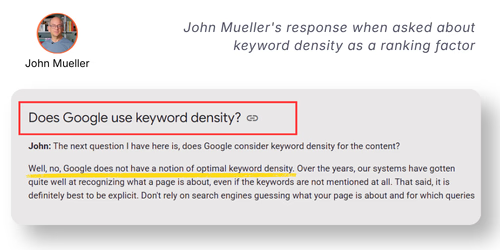
What we actually tell clients: write the page so a reader couldn't easily swap in three or four different topics and have it still read the same way. If your target term could be replaced with something unrelated and nothing on the page would feel wrong, the content isn't specific enough. The primary term and its natural variants end up appearing more often than in generic content, not because we're chasing a percentage but because thorough coverage of a narrow subject produces that pattern on its own.
What we check instead of density: we look at the H1, at least one H2, the opening paragraph and the meta description to see if the primary keyword and its close variants show up naturally, and we read the page for vocabulary a real subject matter expert would reach for without being told to. That's a different exercise than hitting a percentage target, but it tends to produce content that reads as well optimized anyway. Other SEO practitioners have landed on the same checklist, which tells us it's not just a quirk of our own client work.
Do Aged Domains Really Rank Better Than New Domains?
Google has said plainly that domain age itself doesn't help a site rank. We think that statement is true and also slightly beside the point. When we recommend an aged domain for a client entering a crowded niche such as Las Vegas SEO, we're not betting on the number of years since registration. We're betting on everything that tends to travel with an older domain: an existing backlink profile, an indexed content history and some residual trust with users who've encountered the brand before.
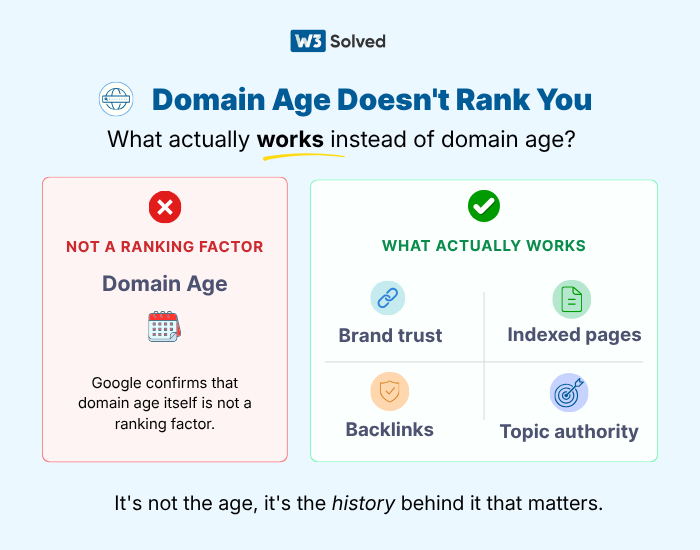
A brand new domain starts with none of that, no matter how good the content is on day one. So while age isn't the actual factor, the things correlated with age often are, and that correlation is strong enough that we still weigh it heavily when a client is choosing between starting fresh or buying into an existing domain with a clean history. A large-scale backlink quality study of more than a million search results found the same thing: the number and quality of referring domains behind a page track ranking position far more consistently than any single technical signal.
Don't buy an aged domain for the age. Buy it for the link profile and topical history behind it, and audit that history carefully before committing. A bad link history on an old domain is worse than starting fresh.
Is There Really No Ideal Word Count for SEO Content?
This one is true in the sense Google means it. There's no universal number that guarantees a ranking, and a 300 word page can outrank a 3,000 word page if it answers the query better. This matters even more for a B2B SEO agency competing for lower volume, harder to rank terms. We tell clients this too, and in the same conversation we tell them to match or exceed the content depth of whatever currently holds the top three positions for their target term.
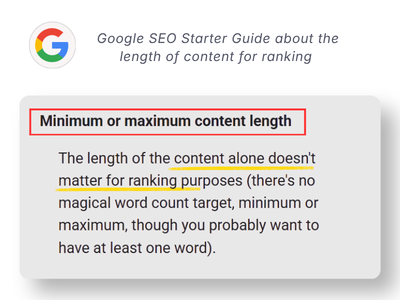
That's not really a contradiction of the spirit of Google's advice, but it does contradict the letter of it, because we are in fact using a number. It's just not a universal one. Benchmarking against the current top results is a more honest predictor of what "enough depth" means for a specific query than any fixed word count Google could ever publish. Broader average post length tracking backs this up too, showing typical top-performing content sits in a fairly narrow band even though no fixed target exists.
How We Actually Set Length Targets
- Pull the top five ranking pages for the target keyword and note their word counts, weighting this lightly if the pages look padded
- List the subtopics and questions those pages cover that a searcher would reasonably expect answered
- Set a target that covers those subtopics fully, then check the resulting length against competitors as a sanity check rather than a goal
- Cut anything added purely to reach a number since padding is easy to spot and increasingly penalized by helpful content systems
Should You Build Links or Just Earn Them?
Google's official position favors organic link earning: create something good enough that people link to it without being asked. We agree that's the ideal outcome. We also know that for most businesses outside of viral consumer brands, including local service clients like our Fort Lauderdale SEO accounts, waiting for links to show up on their own can take years.
What we actually tell clients: proactive, disclosed, relevant outreach isn't a link scheme. Finding journalists, industry blogs and resource pages that would genuinely benefit from citing a piece of content, then asking them to consider it, is standard digital PR. It only becomes a problem when money or goods change hands for the link itself, or when outreach turns into untargeted spam sent to thousands of unrelated sites. We set that boundary with every client before outreach starts.
Does Changing a Publish Date Actually Help Rankings?
Google has said, correctly, that changing a published date without a meaningful content update is a hollow signal its systems try to detect and discount. We tell clients exactly that. Then we also tell them this: when you make a real update, however small, the visible date should reflect it. Both readers and crawlers use that date as a trust signal, and an accurate but stale looking date works against a page that has actually been kept current. As an organic SEO company, this is one of the simplest fixes we make on almost every account we take on.
The distinction matters here. We're not advising cosmetic date changes on unchanged content, which is the exact practice Google warns against. We're telling clients to stop leaving genuinely updated pages showing a three year old date out of excessive caution, which matters even more now that so many queries resolve as zero-click searches directly on the results page.
Should You Use a Disavow File Even If Google Says It's Rarely Necessary?
Google's public position, repeated more than once, is that its systems are generally good at ignoring spammy links without any action from the site owner, and that the disavow tool should be used sparingly, mostly in cases involving a manual action or known negative SEO. Taken at face value, most sites would never need to touch it.
We still run link audits and submit disavow files proactively for clients in competitive, high stakes niches such as finance, legal and healthcare, where negative SEO is a documented risk and a manual action can be severe. We're not disputing that Google usually handles this correctly. We're managing a downside risk for clients where "usually" isn't good enough.
Where this goes wrong: disavowing preemptively based on an automated "toxic score" without manual review is a mistake we warn clients against directly. Generic scoring tools flag plenty of harmless links. Blanket disavowal based on a tool score alone can strip out links that were actually helping the site. We only disavow after a manual, link by link review, never as routine maintenance.
How Much Do Core Web Vitals Really Matter for Rankings?
Google has consistently described Core Web Vitals as a small ranking signal, closer to a tiebreaker between otherwise similar pages than a major lever. Taken literally, that would put performance work near the bottom of most SEO priority lists.
We put it near the top, but for a different reason than ranking. Slow, glitchy pages lose visitors before they ever get a chance to convert, something we see constantly when we run a checkout optimization audit for a client, and it shows up in every account's analytics regardless of what it does to search position directly. Google's own research backs this up, tying longer load times directly to steep increases in bounce rate independent of any ranking effect. So when we tell a client that performance is a top priority, we're technically overriding Google's own framing of its ranking weight, but for a reason that framing never addressed in the first place: performance drives revenue on its own terms.
How Do You Build E-E-A-T Without Faking Expertise?
Google's guidance on Experience, Expertise, Authoritativeness and Trustworthiness, laid out in its own helpful content documentation, stresses that these qualities should be real, not signals added purely for Google's benefit. We agree with the principle completely. In execution, we still deliberately build out author bio pages, add credential details, publish team pages and secure third party mentions specifically because we know these are the exact things Google's quality raters and systems look for when judging E-E-A-T.
Here's the honest version: we don't invent expertise that doesn't exist. We surface real expertise in the specific format that happens to be legible to both readers and Google's evaluation systems. A brilliant subject matter expert with no author bio, no listed credentials and no outside footprint looks, to an algorithm, indistinguishable from an anonymous content farm. Making expertise visible is different from manufacturing it, even though the tactical output looks similar to what a less careful operator might do to fake it.
The test we apply: if a credential or citation we're adding to a page wouldn't survive a phone call to verify it, we don't add it. Everything in an E-E-A-T profile has to be true and checkable, even when part of the reason we're building it is to satisfy an algorithmic signal rather than the reader alone.
Where Do We Draw the Line With Google's Guidance?
Every example above is a case of doing something more specific or more direct than Google's generalized public advice while staying inside the actual spam policies. None of it involves deceiving users or search engines. That distinction is the point of this whole article, so it's worth stating clearly rather than letting it get lost.
What We Never Recommend, No Matter What a Competitor Is Doing
- Cloaking or showing different content to Googlebot than to real visitors
- Paid links or link exchanges built purely to manipulate rankings
- Auto-generated content published at scale and passed off as original expert work
- Fabricated reviews, credentials or authorship
- Doorway pages built only to funnel search traffic through a redirect
The gap between the advice in this article and the list above isn't subtle. One is reading between the lines of oversimplified public guidance using real ranking data. The other is manipulating search results through deception. We'll work confidently in the first category for every client. We won't go near the second, no matter how tempting the shortcut looks or what a competitor is getting away with.
Frequently Asked Questions
Is it against Google's rules to do things Google's public guidance advises against?
Not usually. There's a difference between Google's spam policies, which describe practices that can get a site penalized, and Google's general best practice guidance, which is often simplified advice aimed at a broad audience.
Most of what agencies do differently from the public guidance falls into the second category. It's reasonable, non-manipulative work that goes further than Google's general recommendations, not a violation of the spam policies.
Why would an SEO agency ever give advice that contradicts Google?
Google's public guidance has to work for millions of site owners at once, so it tends to stay general and sometimes understates how much a factor actually matters.
Agencies working across many accounts in the same niche can see patterns in what correlates with rankings that a general help article was never trying to capture. Acting on those patterns, without crossing into anything the spam policies prohibit, is normal practice for an experienced SEO team.
Does keyword density still matter for SEO?
Google has said for years that there's no ideal keyword density and that content should read naturally. In practice, pages that rank well for a term still tend to use that term and its close variants more often than pages that don't rank, simply because covering a topic thoroughly naturally includes the words people search for.
The difference is between chasing a density percentage, which doesn't help, and writing content specific enough to naturally reflect real search terms, which still lines up with what ranks.
Do aged domains actually rank better than new domains?
Google has stated that domain age by itself isn't a ranking factor. Older domains do tend to carry an existing backlink profile, an indexed history and some accumulated trust that a brand new domain hasn't built yet, and those things do correlate with stronger performance.
Paying more for an aged domain is really a bet on that inherited history rather than the age itself, which is a narrower claim than the one Google's statement addresses.
Is manual link outreach considered link manipulation by Google?
Manual outreach asking someone to link to a page isn't against Google's spam policies on its own. What crosses the line is exchanging money or goods for links that pass ranking credit, or joining large scale link schemes built purely to manipulate rankings.
Relevant, disclosed outreach that leads to a genuinely earned placement is standard digital PR, even though Google's general messaging tends to emphasize links appearing on their own through great content.
Want the Version of This Advice Specific to Your Site?
General principles only go so far. If you want a specific, honest breakdown of where your site's SEO can push past the generic playbook, and where it genuinely can't, we'll walk through it with you.
Get a Free SEO Assessment